Description
Help your students stop guessing and start solving long words with confidence!
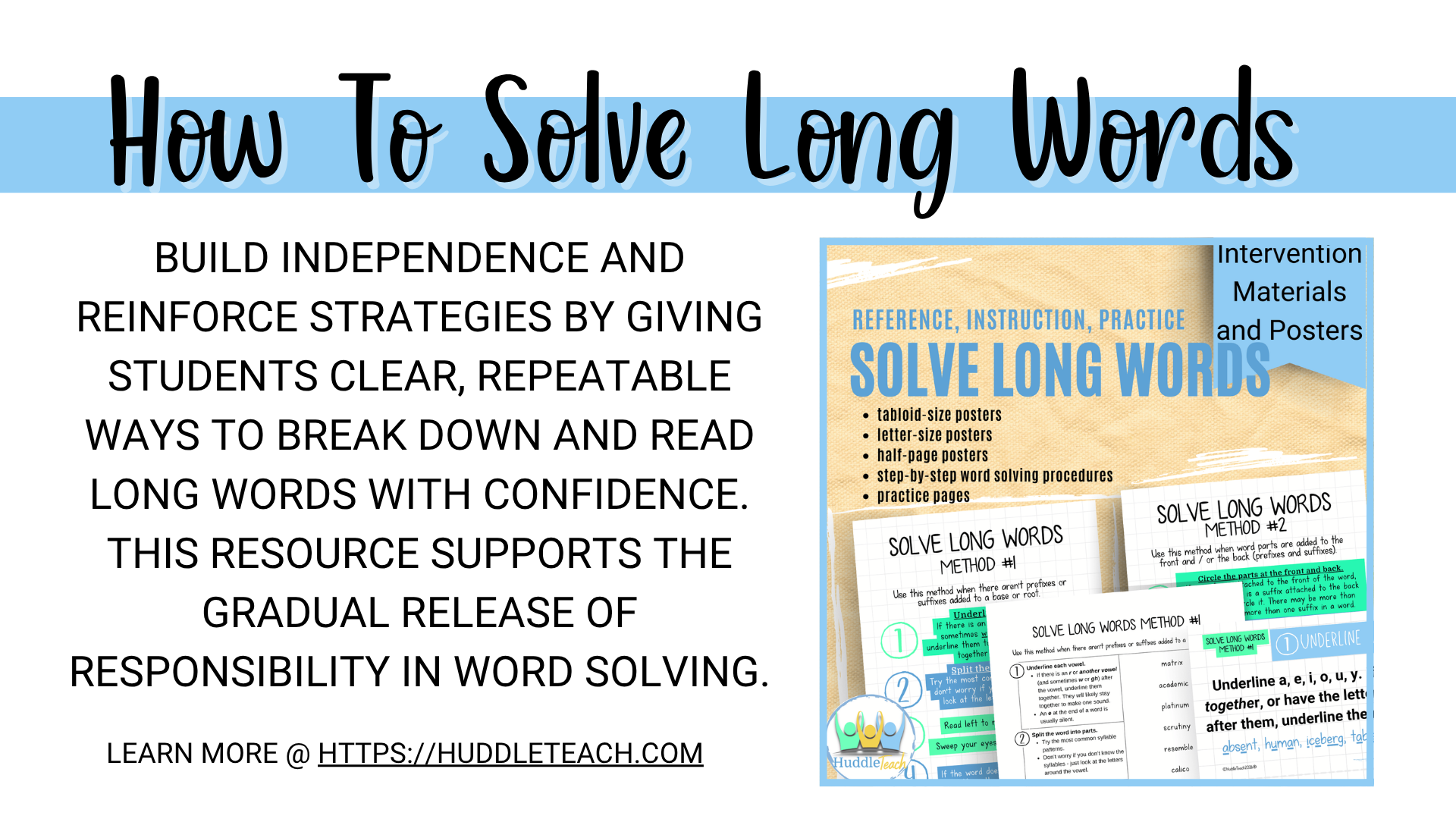
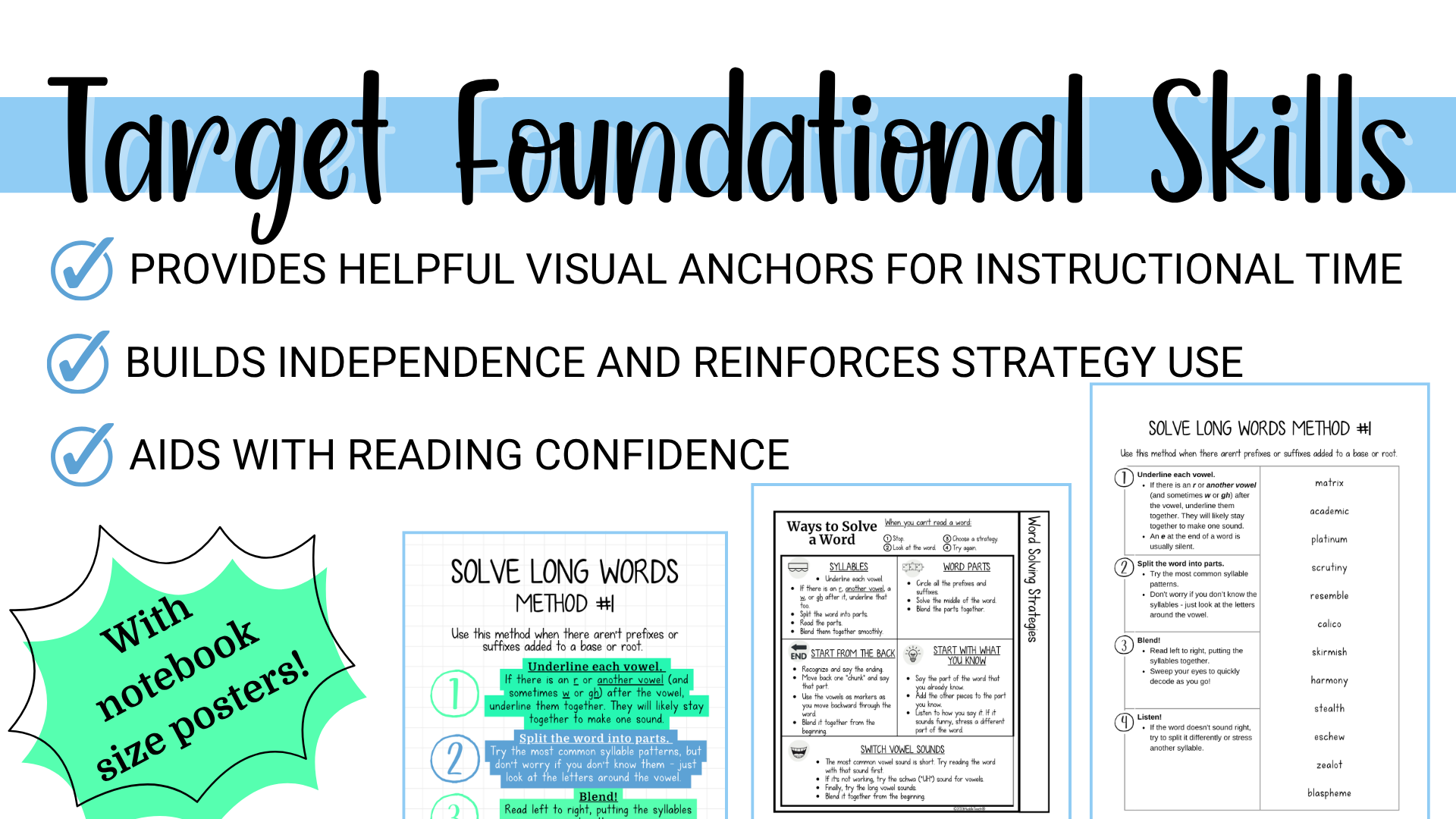
This expanded 54-page resource gives older struggling readers three clear, repeatable methods for decoding multisyllabic words. Students move from teacher modeling to guided practice, word-level application, and connected-text reading.
Instead of memorizing one rigid procedure, students learn how to examine a word, select a useful method, and adjust when their first attempt does not sound right.
THREE FLEXIBLE WORD-SOLVING METHODS
Method 1: Words without prefixes or suffixes
Students:
- Underline the vowels
- Divide the word into syllables
- Read and blend the syllables
- Listen and adjust the pronunciation
Method 2: Words with prefixes and suffixes
Students:
- Circle familiar prefixes and suffixes
- Solve the remaining part
- Blend the parts from left to right
- Adjust the syllable stress when needed
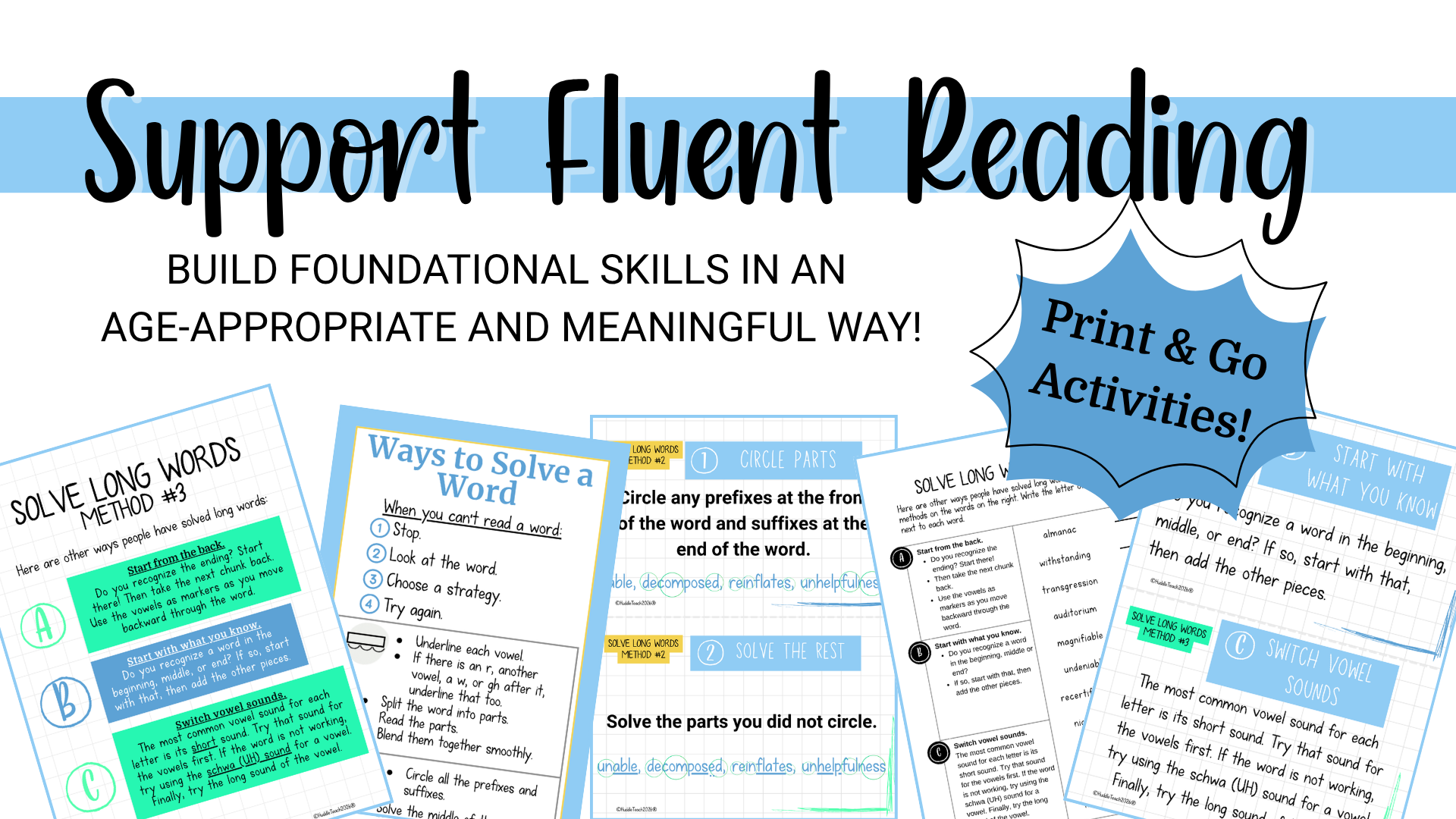
Method 3: Other ways to solve tricky words
Students try another entry point by:
- Starting at the end of the word
- Finding a familiar word or word part
- Switching vowel sounds
- Combining methods when one method is not enough
WHAT MAKES THIS RESOURCE DIFFERENT
- Multiple ways to approach long words
- Students learn that different words may require different methods. This helps them become flexible word solvers instead of waiting for teacher prompts.
- A gradual-release structure
- Materials support the I DO, WE DO, Y’ALL DO, and YOU DO stages of instruction. You can model the process, solve words together, provide partner practice, and move students toward independent application.
- Practice that leads to connected reading
- Students do more than decode words on a worksheet. They apply the methods to high-interest passages about football, cheerleading, and manga.
- Age-respectful support
- The design, vocabulary, and reading topics suit older students who need explicit decoding instruction without elementary-looking materials.
- Consistent instructional language
- The same steps and prompts appear across the posters, bulletin board pieces, bookmarks, notebook reference page, work pages, task cards, and passages.
WHAT’S INCLUDED
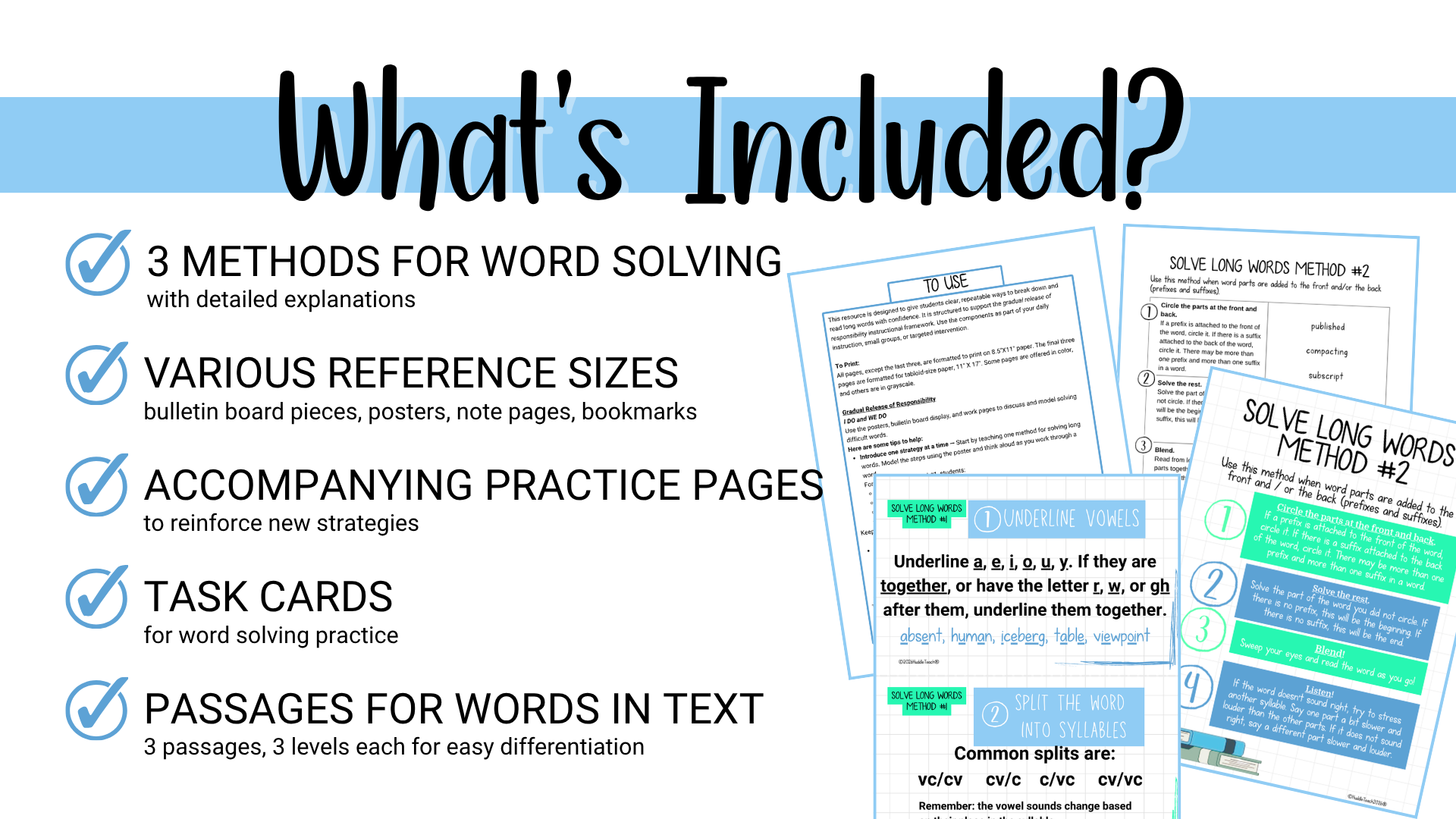
- Three letter-size instructional posters
- Bulletin board title letters spelling “SOLVE LONG WORDS!”
- Bulletin board border pieces
- Method headings and step-by-step bulletin board pieces
- Half-size teaching pages for displaying individual steps
- Color bookmarks
- Grayscale bookmarks
- Composition notebook reference page with a tab
- Three guided practice pages, one for each method
- 26 word-solving task cards
- Student recording page
- “Which Strategy Will You Use?” activity
- Nine connected-text passages
- Three tabloid-size posters for printing on 11″ x 17″ paper
CONNECTED-TEXT PRACTICE
Students practice the methods with passages about:
- How football works and how teams use strategy
- The history and changing role of cheerleading
- Manga features and visual storytelling
Each topic appears at three levels:
- Level A: approximately 800–950L
- Level B: approximately 1000–1150L
- Level C: approximately 1200–1350L
Each passage includes opportunities to identify difficult words, select a word-solving method, and explain how the method helped.
HOW TO USE THIS RESOURCE
- Introduce one method at a time
- Model each step with a think-aloud
- Display the posters or bulletin board pieces as teaching anchors
- Complete the work pages during whole-group or small-group instruction
- Use the task cards for partner practice, stations, intervention groups, or independent work
- Add the reference page to composition notebooks
- Give students bookmarks for support during reading
- Use the leveled passages to help students transfer word-solving skills into connected text
Older struggling readers do not need longer lists of disconnected rules. They need dependable routines, flexible options, and repeated opportunities to apply those options during actual reading. This resource provides the support students need while steadily moving the thinking and problem-solving into their hands.
Do you work with middle school or older students and are unsure of how to explain and teach these kinds of decoding skills to striving readers? Don’t fear! The Solve It! Series details every step you need to take to help your students solve long words, and these three blog posts help you be efficiently effective in your instruction:
- Working with Middle School Struggling Readers – Decoding
- Decoding Skill Errors in Middle School
- Five Ways to Help Middle School Readers
Prefer to shop on Teachers Pay Teachers? Click here to follow our store and view our products!