

Description
Do you provide reading comprehension intervention for secondary students using literary text? This print-and-go resource helps you teach conflict and plot through structured, hands-on lessons designed for students who need more support.
Students often memorize the parts of a plot diagram without understanding how those parts connect. This resource begins with the concept of conflict, then shows students how conflict grows through rising action and shapes the entire plot.
With more than 115 pages, you receive more than three days of lessons, manipulatives, practice activities, and assessment options.
Day 1: Concept and Types of Conflict
Use a scripted lesson and hands-on sorting activity to build students’ understanding of conflict. Students connect conflict to familiar movies, television shows, and video games before applying the concept to literary text.
Students learn to:
• Define conflict in a narrative
• Distinguish between internal and external conflict
• Identify major and minor conflicts
• Recognize seven types of conflict
The seven conflict types include:
• Character vs. Self
• Character vs. Character
• Character vs. Nature
• Character vs. Society
• Character vs. Technology
• Character vs. Supernatural
• Character vs. Fate
This lesson includes conflict labels in three sizes, blank labels for additional examples, Conflict Confusion task cards, student response pages, and an answer key.
Day 2: Understanding Rising Action
Students organize and compare two sets of story-sequencing cards. One story presents a simple series of events, while the other develops an escalating conflict.
Through this comparison, students learn that rising action is not simply a list of events. It shows the conflict increasing in intensity and moving the story toward its turning point.
This lesson includes two sets of story-order cards and an additional set of Flat or Rising task cards for students who need more practice.
Day 3: Applying Conflict to a Plot Diagram
Students connect conflict and rising action to the complete structure of a story. They use the sequenced story, a written passage, and plot diagrams to identify and explain:
• Exposition
• Inciting event
• Rising action
• Climax
• Falling action
• Resolution or conclusion
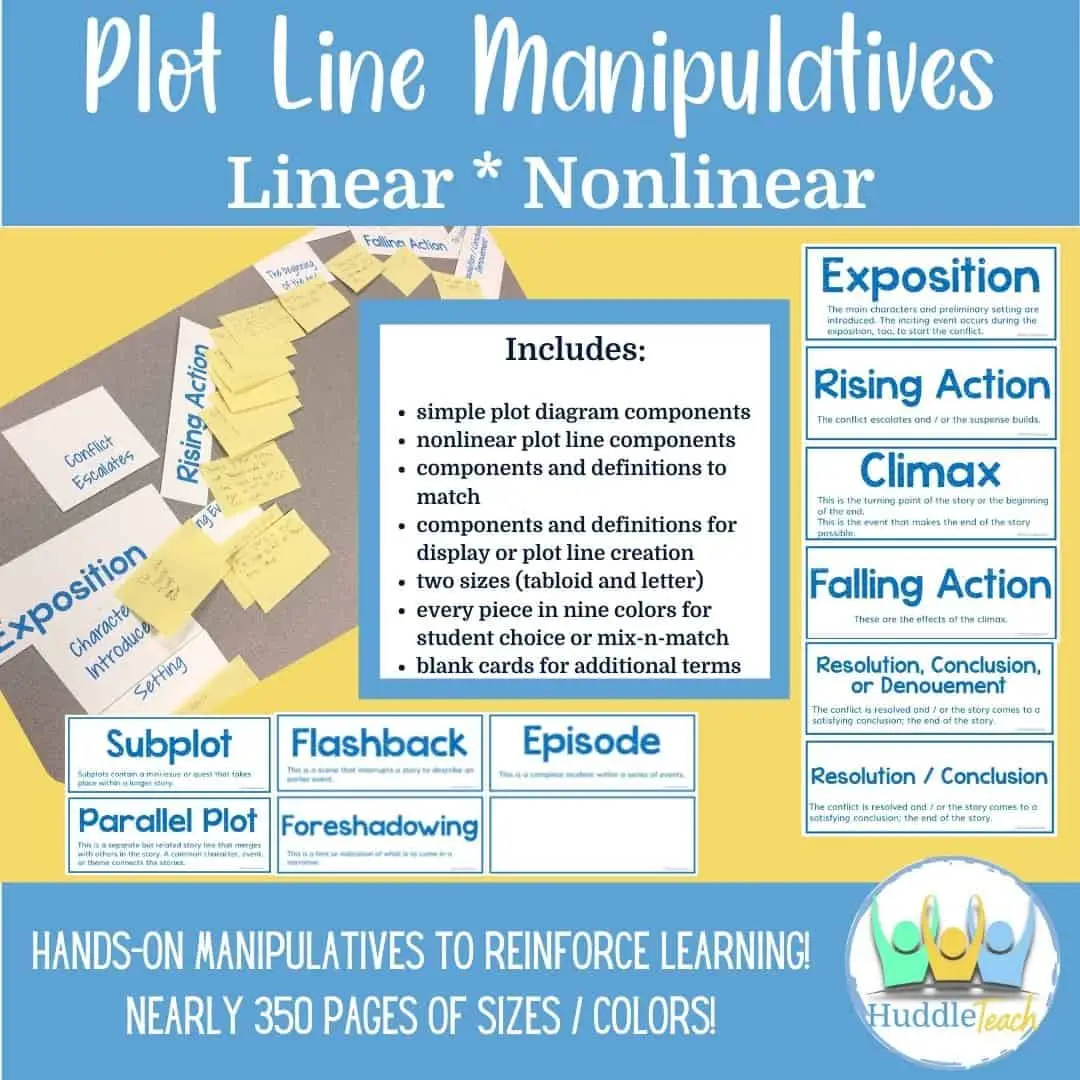
This lesson includes three sizes of plot diagrams, with 20 options in each size. Multiple versions allow you to select the format that best matches your students’ abilities and your approach to teaching plot.
What is included:
• More than 115 pages
• Three detailed, scripted lesson plans
• Teaching notes, definitions, and instructional guidance
• Conflict labels and posters in three sizes
• Internal and external conflict labels
• Seven character conflict types
• Blank labels for additional examples
• Conflict Confusion task cards
• Flat or Rising task cards
• Two sets of story-sequencing cards
• A complete written story for plot analysis
• Student response pages
• Answer keys
• Plot diagrams with and without the inciting event
• Multiple plot-diagram formats
• Letter, Legal, and Tabloid printing options
The manipulative pieces can be printed on Avery products #8387, #5689, compatible generic products, and #5392. You may also print them on colored paper, laminate, and cut them for repeated use.
Use this resource for:
• Secondary reading comprehension intervention
• Middle and high school ELA
• Special education
• Small-group instruction
• Whole-class reteaching
• Literacy stations
• Collaborative learning
• Formative assessment
• Review before literary analysis
• Interactive classroom displays
This resource supports the noted standards and provides intervention-level instruction for comprehending grade-level literary text, understanding nonlinear plot lines, and addressing Texas Reading Elective TEKS b.7.C.
The resource also includes a link to a related blog post with additional information about using plot diagrams during intervention.
This item supports CCSS: RL.9-10.5, RL6.3 and TEKS LA.8.7.C, LA.7.7.C, LA.6.7.C